Where Solid Surface fails
Solid Surface materials such as Corian®, HIMACS®, or Staron® can be thermoformed, but not every heating method is equally suitable. These materials have a narrow processing window, low thermal conductivity, and are sensitive to uneven or uncontrolled heating. The wrong heating principle can lead to bubbles, cracks, discoloration, and scrap from high-value material.
The decisive question is therefore not which system is cheapest, but which system ensures process stability, protects material value, and delivers reproducible quality.

Contact heating
- Heat is transferred directly through heated metal plates – fast, uniform, controlled.
- Heating time approx. 1 minute per mm of material thickness.
- The platen temperature acts as a natural upper limit – no uncontrolled overheating.
- Recommended by DuPont and LX Hausys for Solid Surface thermoforming.

Convection heating
- Heated air is guided over the material – slower and more dependent on airflow and geometry.
- Heating time approx. 5 minutes per mm – approximately five times slower.
- Temperature stability depends on oven geometry, airflow, and workpiece size.
- Better suited for unfilled thermoplastics or complex three-dimensional freeforms.
What this means economically
The choice of heating method is not a purely technical decision. It determines how many parts can be produced per day, how reproducible quality is, and what a defective component costs.
Shorter heating times mean higher throughput. More precise temperature control means less scrap. Process reliability means predictable unit costs.
The real cost question:
A less expensive system with unstable processes saves money once – at the time of purchase. After that, it continuously generates costs: material scrap, rework, delivery delays, and complaints. These costs do not appear in the purchase price. They appear in your P&L.
- Material scrap: high-value material that can no longer be used
- Rework: unplanned labour time that was not included in the calculation
- Delivery delays: schedule risk when rework is required
- Complaints: cost, effort, and loss of customer trust
- Reduced throughput: fewer parts per shift, lower utilization and productivity
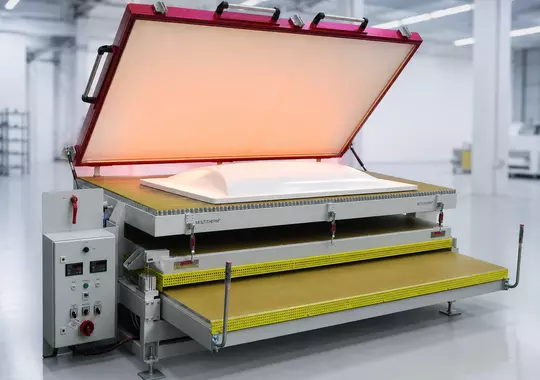
ELKOM Multitherm – contact heating as a system solution
ELKOM Multitherm is our system solution for thermoforming Solid Surface materials, developed on the basis of controlled contact heating, robust system architecture, and more than 40 years of application and process experience in industrial heating technology.
Leading Solid Surface manufacturers confirm the relevance of the principle: DuPont refers directly to ELKOM in its Corian® thermoforming documentation. LX Hausys explicitly recommends contact heating for applications where precision, speed, and uniform heating are critical.
Further information
What you can look forward to:
Get concrete information on thermoforming applications and find out whether ELKOM Multitherm is the right solution.
These and other questions are covered in detail in the whitepaper.